

MODULE 6: Creative use & health promotion for seniors using modern technology
Introduction
The profile of the seniors when it comes to IT competences and how experienced seniors are when it comes to use a computer and to work with a computer on daily life differ very much. In some EU member states it is very relevant to offer basic introduction to very basic and very important skills and competences. In some countries the majority of senior citizens have passed this level and in many EU-member states a minor group are very familiar using the computer on daily basis for trade, banking, communication and so on.

Danish elderly people have become significantly more digital in the last 10 years and use the Internet more than their peers in the EU’s other 28 Member States. However, the Danish elderly are not without digital challenges.
The digital development among Danish elderly people between the ages of 65 and 74 has accelerated over the past 10 years. From 2009-2018, the proportion of Danish elderly people who have never used the Internet has fallen from 44 to 6 per cent, while the proportion who have used the internet in the last three months has increased from 52 to 92 per cent.
Internet use is thus more common among Danish elderly people than among older people in the EU’s other Member States, where only 56 percent of older people have generally used the Internet in the last three months. In addition to Denmark, the Netherlands, Sweden, Luxembourg and the UK are also in the digital top five for older people who regularly use the Internet. In all five countries, the proportion is over 80 per cent.
This survey covers only older people aged between 65 and 74, as comparable figures are available across the EU for this age group. Figures for Danes over the age of 74, and their use of internet, can be found in IT application in The Population and at the bottom of this article.
One in six elderly people have never used the internet
By 2009, 44 per cent of Danish elderly people had never used the internet, a proportion that had fallen to 6 per cent in 2018. In the Danish population as a whole, 4 percent had never used the Internet in 2018. The 6 per cent of older people who have never used the Internet are the lowest proportion in the EU, where 37 per cent of older people have never used the Internet on average.
On this parameter, the Netherlands, Sweden, Luxembourg and the UK again occupy the digital top five, while the populations of Greece and Bulgaria are among the least digital.
The oldest are the least digital
Older people aged 75-89 are the population in Denmark that uses the Internet the least. In this group, 23 per cent have never been on the internet, which is a significantly higher proportion than the population average of 4 per cent. However, 75-89 year olds have also made digital progress in recent years, and from 2010-2018 the proportion of this group who have never been on the internet has fallen from 66 per cent to 23 per cent. The 23 per cent elderly who have never used the internet equate to around 100,000 people
People who have never been on the Internet
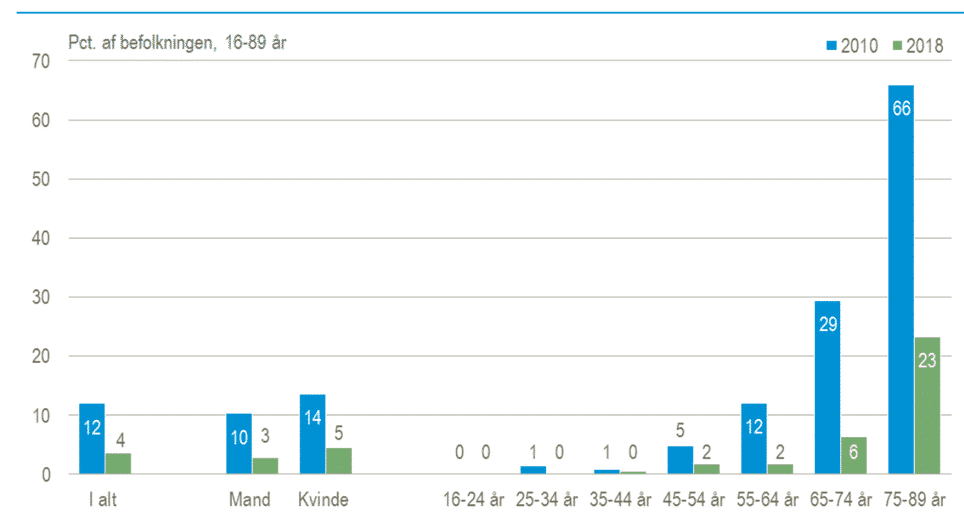
https://www.dst.dk/da/Statistik/bagtal/2019/2019-04-23-danske-aeldre-er-de-mest-digitale-i-eu
In 8 years, the proportion fell from 66% to 23% a decrease of about 5% per year. Now another 3 years have passed – which has probably pushed further to the positive development. The figures, of course, mask the fact that those who enter the age group 75-89 years have the competences with them + that the group is continuously reduced naturally by a fairly high number of people per year when you are aged 89 or more.
But this rapid development is not only happening in Denmark – it is also happening continuously in all other countries – although there are many countries that still need a strong focus on getting senior citizens and future senior citizens more digitally competent in relation to the areas the first 4 modules focus on. But even in a country like Greece, which has a low digitization rate of older people, it is worth noting that 35% of the senior group surveyed have been active online in the last 3 years. So many seniors will be ready for senior IT 2.0 and 3.0 in all EU-member states.
One of the lessons learned by the COVID-19 pandemic and the lock downs that followed was that we all need to be able to entertain ourselves, stimulate, train and maintain our cognitive and mentally wellbeing.
Technology contain and offer senior citizens a world of opportunities in addition to the very important and basic skills trained in the previous modules.
To these groups it is relevant to go for senior IT 2.0 or perhaps even 3.0.
In Slow Learning we define 3.0 as the level where seniors use the computer, to
- To express themselves creatively
- To be innovative
- To promote own health
This module will introduce some of these many options to the educators/trainers in Senior IT.
The modules will switch between what is possible and assessable on a computer and what is possible and assessable on an Ipad – Iphone
Content description
The module contains 4 units.
- Unit 1: Making and editing a video.
- Unit 2: Have to make your old photos “alive” as a part of your family videostory.
- Unit 3: How to paint on an Ipad.
- Unit 4: Use the internet to promote your health.