

Let’s be clear: you cannot identify any specific learning processes or learning models that are particularly suitable for the senior learner and from which the senior learnr will benefit greatly. The senior learners are as different from each other as other learners.
But it is always important that you as a teacher reflect on how you plan, teach and teach others, and that you as a teacher continuously reflect on how different people learn.
As a contribution to these reflections, we will introduce.
A learning model.
The Danish professor Knud Illeris (1939-) has developed a relevant theory of adult learning, where he points to several elements that influence the result and benefits of learning something practical.
The model includes both the acquisition of new knowledge and skills and the importance of the driving force, i.e. the learner’s motivation and desire for learning. In addition, he emphasizes learning as a social process, where learning always takes place in interaction between the individual and the surroundings.
Learning is thus understood at Illeris at the same time both as an individual process and an interaction process.
Illeris’ learning theory applies both where the learner sets goals for his own learning and where the learner sets goals for the desired learning. The theory of learning is often expressed in a learning model, which at the same time creates an overview of what can be at stake in learning.
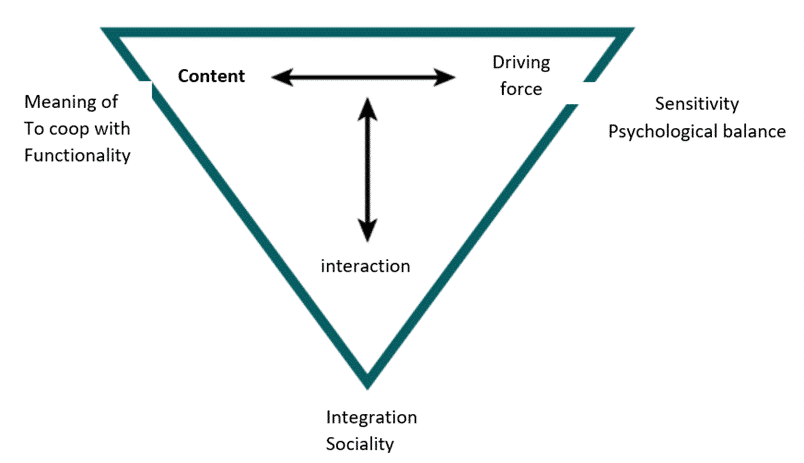
The model describes two processes:
- The acquisition process is drawn on the model as a horizontal double arrow between DRIVE and CONTENT. Illeris points out that the acquisition process only works at the individual level, i.e. that the acquisition process takes place in the individual. In the process of acquisition, the interaction with the outside world is processed. For students in internships, it is about the interaction with the manager, colleagues, children and parents, users and relatives in the institution.
- The interaction process is on the model drawn as a vertical double arrow. This is about the interaction of individuals with the surroundings. According to Illeris, learning cannot be understood without considering the context or context in which the individual is included.
The model also contains three dimensions.
The first dimension is the content.
In the content dimension, the teacher strives to create meaning as well as to master and function appropriately in relation to the surroundings.
The second dimension is the driving force,
mobilization of psychic energy. Motivation, emotions, curiosity, joy and willingness to learn more about themselves, colleagues and pedagogical practice. Illeris emphasizes that driving should be thought of as a very important dimension in relation to learning, as people differ in motivation, emotions, will and sensitivity. It also has an impact on possible resistance to learning.
The third dimension is about interaction.
This dimension includes working with action, communication and cooperation to strive for integration and sociality.
Illeris believes that people strive for sociality and to be part of a community.
 According to Illeris, learning leads, on the one hand, to a change in capacity in the individual and, on the other hand, learning should be understood as an over-concept in which:
(…) a number of processes, referred to in words as socialization, qualification, competence development and therapy, fall within the chosen concept of learning and are considered as specific types of learning processes or as special angles from which to perceive learning.
With Illeris’ learning theory, the learner is challenged to already in the planning/formulation of the learning goals – to express themselves about the way the learner thinks he learns it best and easiest.
Source https://paedagogik.systime.dk/?id=296
Learning styles
By Head of ASB LearningStylesLab, Associate Professor Mag. Art. Ole Lauridsen, 2010
What are learning styles?
Learning styles are the methods we use to concentrate on new and difficult information
- and take this information in.
- process it into knowledge
- store this knowledge
- use this knowledge again.
There are various theories about learning styles and in the following describes Dunn’s and Dunn’s learning style model, which operates with 20 elements, divided into 6 groups that can positively or negatively affect our learning. Positive when you get the opportunity to learn and work in the ways you prefer and that you are good at, and negative when you are forced to learn and work in ways that do not fit well with you.
It is important to remember that learning styles must be used when it comes to learning or working with something new and difficult – i.e. when we “new teacher”.
When we repeat or learn something in an area that we know well in advance, i.e. when we “teach”, learning styles are not quite as necessary; but it now never hurts to use your strengths or preferences as much as possible.
“The only right way to learn is my way of learning!”
This is the basic idea of Dunn’s and Dunn’s learning style theory, and this basic idea means, of course, that the individual must know his profile and know what strategies he or she can put in, not least if the teaching, for example, does not exactly correspond to one’s actual needs.
Such a profile can be established on the www.learningstyles.net.
Here you will find a comprehensive test developed according to recognized methods and which gives a reliable result. The profile provides a wide range of strategies to put your strengths or preferences into practice. Learning styles provide understanding for others, a common language and community.
When you work with learning styles, you learn a lot about yourself.
But at the same time, you get to see that others can learn and work in a different way, and that recognition leads to increased respect for others and greater tolerance.
Learning styles can thus greatly make collaboration better – and more fun.
In addition, you get a language about much of what happens in learning, a language you can use with colleagues and other learners.
This common language is completely neutral – you come from the infertile “you-are-always-so-…” discussion to a discussion that is solely about a diversity that is well founded and understandable.
The results of the work on learning styles can thus be summarised in:
- self-awareness
- better results
- better cooperation
- increased community
The learning style model
Dunn’s and Dunn’s learning style model looks like this (here in the adult edition, “Building Excellence” developed by Rita Dunn and Susan Rundle):
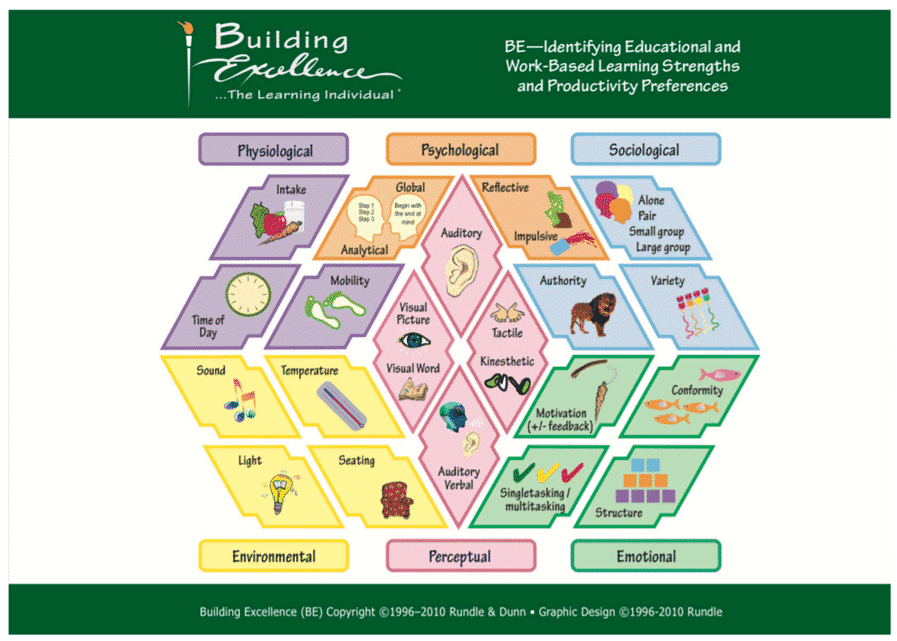
Let’s look at the individual groups and the individual elements:
The perceptual elements – the sense(s) we prefer to use when we need to take in new information. In this group we find:
- the auditory – learning by listening and only by listening, e.g. to lectures, lectures or audiobooks
- the image-visual – to learn by viewing images and graphic representations of all kinds, e.g. paintings, photographs, drawings, signs, tables and graphs
- the text-visual – learning by reading, e.g. books, journals, text on the PC
- the tactile – learning by involving fine motor skills, i.e. your fingers, e.g. by taking notes (although you may not read them again), drawing doodles, clicking or playing with a pen, or knitting while learning
- the kinesthetic – to learn by including coarse motor skills, i.e. the whole body, e.g. in floor games and games, by walking around reading or listening, rocking in a chair or on a pilates ball while learning or learning by involving your whole person, e.g. in role-playing and casework
- auditory verbal – learning by thinking out loud, talking to and asking questions.
Most people have more sensory strengths, so it’s a powerful simplification to talk about hearing, seeing, feeling or doing people – and in addition to the senses, there are many other things at play in a learning style profile as well.
The psychological elements – partly the way we prefer to process information and partly two ways we respond when answering questions, making decisions and solving tasks:
Information processing:
- analytical – preference is given to the information delivered step by step in a logical presentation based on the full picture and the full understanding
- global – you need an idea on the subject and an overview before presenting the details. Let’s put a more concrete picture of this difference:
If you are going from one place to another, an analytic person would prefer a one-step driving directions walk through the route.
 Conversely, a global person cannot do anything with the many details of a directions if he or she has not seen a map of the route in advance. Some people can take an analytical and global approach; they are called integrated. It is important to note that although analytical or global actually describes only how our brains best process information, an analytical person will often adapt very structured in all conditions (with timetables, to-do lists, agendas, overviews, fixed rules); conversely, a global person will rarely be able to learn and work in a rigid framework, but will tend to take things as they come. These differences often cause problems in e.g. management and teaching, because global people will have a hard time with fixed frameworks and systems, and analytical will not thrive in a global environment without this framework.
Reaction patterns:
reflective – you need time to think before reacting.
impulsive – spontaneously engage in answers, decision-making and problem solving.
The physiological elements – bodily conditions that must be considered in order to concentrate and maintain focus:
- the small eating – need to take in energy while learning and working, e.g. eating and drinking a little.
- time of day – we are all equipped with a biological clock and peak and bottom differently over the course of the day. Some learn best early in the day (from waking up to around 10am), some in the middle of the day (around 10am- 3pm), some late in the day (around 3pm- 7pm) and some at the end of the day (from about 7pm) and/or at night.
- need to move – walk around a bit, stretch, get up because you get tired and uneasy in your body when you have to sit in the same seat for a long time at a time. This is different from the kinesthetic where the body is involved as a kind of sensory canal; this is only a case of fatigue and agitation in the body.
The environmental elements – conditions in the learning space that, like the physiological elements, have an impact on concentration and focus:
- sound – some learn and work best in silence, others must have sound (usually music) in the background
- temperature – some learn and work best in warm rooms, while others prefer cool.
- light – some prefer bright and direct light when learning and working; others feel better about more dim light
- workplace and position – some prefer to sit at a traditional workbench (e.g. school table, desk or meeting table), while others can best concentrate if they sit more comfortably (e.g. on a sofa) or lie down.
The emotional elements – conditions that need to be considered in order for us to emotionally get started with a new and difficult task, and which have an impact on how stressed we become:
- motivation – some need feedback and therefore want to know if they are doing the right thing, while others cannot work if they are seen over the shoulder by others. This is not motivation in the normal broad sense, i.e. it is not about the psychic energy, i.e. the desire or the will you display when learning and working.
- conformity – some must have choices in the learning situation or need to discuss it and ask questions about the whole set-up, simply to get it under the skin and be able to relate to it; they are non-conformist. Others do not have that need, but follow the flow; it’s the conformist.
- single-tasking/multitasking – some prefer to finish a task before embarking on a new one; it is single-task. Others prefer to switch between multiple tasks; it’s the multitasks. Many believe that multitasking is an expression of a lack of concentration, but if you keep your goals in mind as a multitasking, you are exactly the same as the single task.
The single-task person, for its part, should pay attention to moving forward and not linger in the same task.
- structure – some need to get a structure in the fabric from the teacher’s side before embarking on
- the work (by getting questions and tasks in advance); others will feel such a pre-given structure as a straitjacket and would rather even work with the fabric without detailed instructions.
The social elements – the personalities we learn and work in best: alone, in pairs, in small groups, in larger teams, possibly with a teacher or a superior. You may want variety in these groupings, but many people feel comfortable working according to the same pattern all the time.
Learning styles are equal
There are no elements in the model that are better than others.
It is no better to be auditory (learn by listening and only by listening) than it is to be kinesthetic (learn by using the body or your whole person). After all, it is all about bringing out the best in each of us, in the area of learning and work, and if you distance yourself from, for example, kinesthetic learning, it is only because of a tradition that is not at all justified by our knowledge of learning.
Incidentally, the vast majority of people between 6 and 14 have strengths or preferences in their learning style profile.
There are areas within the model where the vast majority, specifically just over 70%, have strengths: the senses, the information processing, time of day, light and workplace, and the working position. If you take care of them, you hit most people.
Learning styles are dynamic
You are not put in a booth by having your learning style profile prepared, because your profile can change over time under the influence of the surroundings. For example, only just over 10% of children have a strength within the auditory (learn by listening and only by listening), but if we take an adult group there is small 30% – we live in a very speaking society, so the auditory strength develops in some.
 Similarly, among children there are almost exclusively global (learn from wholes), specifically small 90%, while the last just over 10% prefer an analytical approach. Among adults, the global group has shrunk to 55% and the other 45% is divided into 28% analytical and 17% integrated – the analytically oriented society makes its mark. In addition, there may be minor differences in the individual from one learning or work situation to another. Some may want to work with someone else in general, but there may then be a few areas where they would rather sit alone. Some generally prefer music in the background, but if they have to work with e.g. numbers, they may prefer to sit completely at rest.
Source: https://guga.gyldendal.dk/~/media/Munksgaard/Lissi/Undervisersite/L%C3%A6ringsstile.ashx
Comment
It is crucial that the teacher is aware that in a given course group of senior citizens, on an equal footing with all other student groups, there will be students with very different experiences with learning. Senior students will present very different prerequisites for learning and very different approaches to being a student and student. Diversity will often be even more pronounced in a student group consisting of senior citizens than among a student group consisting of younger ones.
Students on a senior class that has not received classes will regularly appear in the student role since leaving the national primary school at the age of 10 to 15. Some, but certainly not all, will access the course with expectations based in part on their memories of the time and so will learning participation and approach reflect the role assigned to them at the time.
By virtue of their work, personality, others have participated in learning activities and course activities throughout their lives and perhaps just a few weeks before they show up for this course.
It is important to be aware that some seniors will show up with a desire to learn, but with great doubts about their own abilities and competences to learn what they would like to be able to do.
If you have students you sense are characterized by these doubts, you must of course start with the very simple. In addition, it can be fruitful to start a small dialogue about when they last learned something new – and how it happened.
Be careful not to expose elderly people by asking them in plenary. It can be very cross-border and stressful to be questioned – and especially if you can’t actually answer or explain.
Few senior teachers will be aware of what learning style they have if you use that word.
Therefore, it is a good idea to start from what Dunn and Dunn formulate in the following way.
“The only right way to learn is my way of learning!”
Ask senior students how they think they learn something automatically best. How best to learn to remember sequences best?