


1.2 Knowledge of aging in terms of retention and cognitive abilities.
In 2018, the Danish National Research and Analysis Centre for Welfare published the results of a number of studies that focused on maintaining cognitive abilities in old age in the report:
Elderly people’s health, functional capacity and lifestyle Analyses based on the 5th wave of the Elderly Database and the development between 1st and 5th wave 1997-2017
https://pure.vive.dk/ws/files/2029184/_ldres_helbred_funktionsevne_og_livsstil_A_SIKRET.pdf
 Figure 5.1 shows that the vast majority (83 per cent) of respondents in 2017 aged 67-97 have very good cognitive abilities. In other words, they have had no difficulty at all in concentrating or learning anything new (sum index score = 0) in the last 30 days. A further 13 per cent have minor difficulties (sum index score = 1-2). Conversely, only 1 per cent have severe difficulties in either concentrating or learning something new or having moderate difficulties with both (sum index score = 5-8).
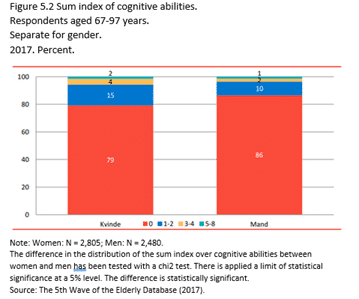 We know that women, to a lesser extent than men, consider that they have no problems with their physical ability to function. The same applies to cognitive abilities, see Figure 5.2. Thus, men aged 67-97 (86 per cent) have indicated more often than women (79 per cent) that they have had no difficulty concentrating or learning anything new (sum index score = 0) in the last 30 days. On the other hand, a higher proportion of women aged 67-97 reported having minor, moderate or severe difficulties (sum index scores 1-2, 3-4 and 5-8 respectively 15, 4 and 2 per cent as against 10, 2 and 1 per cent among men). The difference in the distribution by sum index between women and men is statistically significant.
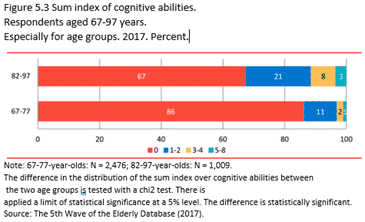 As was the case with physical functioning, the proportion of older people living without cognitive difficulties decreases with age. Figure 5.3 shows that the proportion without cognitive difficulties is 86 per cent among 67-77 year olds, while it is 67 per cent among 82-97 year olds. Similarly, overall, only 3 per cent of 67-77 year olds score 3-8 on the sum index, corresponding to having moderate to severe cognitive difficulties, while the proportion is 11 per cent overall among 82-97 year olds. The difference in the distribution by sum index across the two age groups is statistically significant. It is obvious to assume that some of the difference between women’s and men’s cognitive abilities for the benefit of men, which we found above, is due to the fact that women are on average older than men.
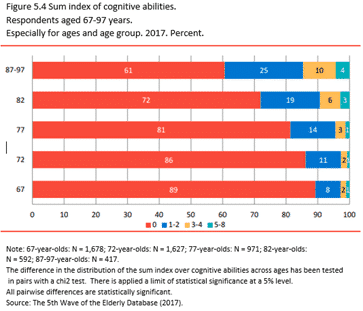 Cognitive abilities, like physical ability, are continuously decreasing with age. Figure 5.4 shows for all ages (though with 87-97 year olds as a single age group due to a flimsy data base for the oldest elderly) that the proportion of older people living without cognitive difficulties decreases with increased strength with age – from 89% among 67-year-olds to 61% among 87- to 97-year-olds. Similarly, the proportion who have minor, moderate or severe difficulties (sum index scores 1-2, 3-4 and 5-8) continuously increases from a total of 11% among 67-year-olds to a total of 39% among 87-97 year olds. All paired differences in distribution between ages are statistically significant. The pattern across ages is found among both women and men, although most pronounced among women (not shown).
Reflection.
There are no clear explanations for what causes the slight decrease in overall cognitive acquisition competence. It can be caused by the fact that it is actually the first challenges that appear as signs of a brain disease.
More obvious is that:
- that many more older people than young people may suffer from un recognized stress of life. A special feature of a long life is that you have experienced more existential losses in life than younger ones and that very few older people seek help to deal with these losses and the stress of life these losses can trigger in many.
- That many older people are untrained in terms of learning new things, because their life circumstances require new learning to a lesser extent than younger ones. The brain acts in exactly the same way as a muscle. If challenged regularly, it develops – it is not regularly challenged to reduce functional capacity.
- The distribution of this target group survey and what is noted as possible causes will also be approximated and mapped among younger groups.