


Lets’ think about motivation
Without the technology that benefits an increasing majority of the population, older people do not have access to the same information and opportunities as the young people. They may as a result begin to feel over time that they have less in common with younger people and other members of the community. Quite simply, they lack the same opportunities and begin to feel more isolated as they find younger people talking about things that they have no knowledge or experience.
Technology is becoming a bigger part of everyone’s life, making it easier for people to:
- maintain contact with family, friends and a wider group of individuals with whom they have something in common, such as work, hobbies or experiences
- gain access to information about activities and services that meet their interests and needs
- learn new skills and keep their brains active
- engage in paid work and volunteering
- find the best prices/solutions for products and services.
It is highly important to keep up and promote the motivation of seniors during teaching and training. Being aware of the many motivating factors is important for teachers and trainers, as each person differs from the other. Seniors need to feel that the motivation is relevant with their needs. The desire to improve one’s well-being is a strong motivator for learning.
Learning keeps seniors actively involved with other people. More specifically, in a classroom a senior is involved with the other learners and the trainer. They ask questions, share ideas and practice new skills. The classroom offers them the opportunity to interact by discussing and work in groups. The interaction helps seniors to maintain their focus on the learning activity. Seniors are often motivated to engage in learning experiences not only to acquire knowledge, but also to develop social relationships.
 Another critical aspect for the motivation of seniors is the trainer. The trainer can motivate seniors to learn and keep them focused on the learning process. The trainer can make a learning experience interesting. He has to be enthusiastic, interesting, and knowledgeable about the subject, in order to make seniors to understand it. However, being knowledgeable is not enough. A comprehensible learning experience is also important. What seniors need is a simple and well-organized learning procedure. Presentations and visual displays can be helpful. Moreover, a trainer must recognize the knowledge and the experiences of seniors and respect their ability and willingness to learn. When a senior interact with a trainer with these characteristics, is more possible to want to enroll in learning activities.
Seniors are not interested in learning something that has no connection to their past, present, or future. When they have to choose about they want to learn, they usually prefer learning experiences that expand their knowledge or they are familiar/relevant with their lives. They stay focused and interested in subjects that they are meaningful to them.
The two basic motivations of seniors for using technology are the social connection and learning new information. The connection with family is a very important topic for the seniors. They want to stay in touch with relatives or friends, overcome loneliness and feel connected again. Especially, since the pandemic began, seniors understood the risk of meeting people and they have to find ways to keep in touch with their loved ones. Besides the social aspect, learning new information is a strong motivation for older people to learn how to use ICT. People of that age, that is more likely to stay at home, want to have easy access to information about topics they are interested in, to feel independent and able to cover their needs.
Aspects that a trainer has to consider:
- Explain the value
- Internet safety
- Emphasize the benefits
- Encourage making mistakes
- Creation of a calm atmosphere for the learners
- Patience and repetition are important in the learning process of older people
- Start with easy exercises that motivate
- Social interaction is good motivation
- Speed of learning
- Attitude of the learners
- Constant practice
- Write down important information
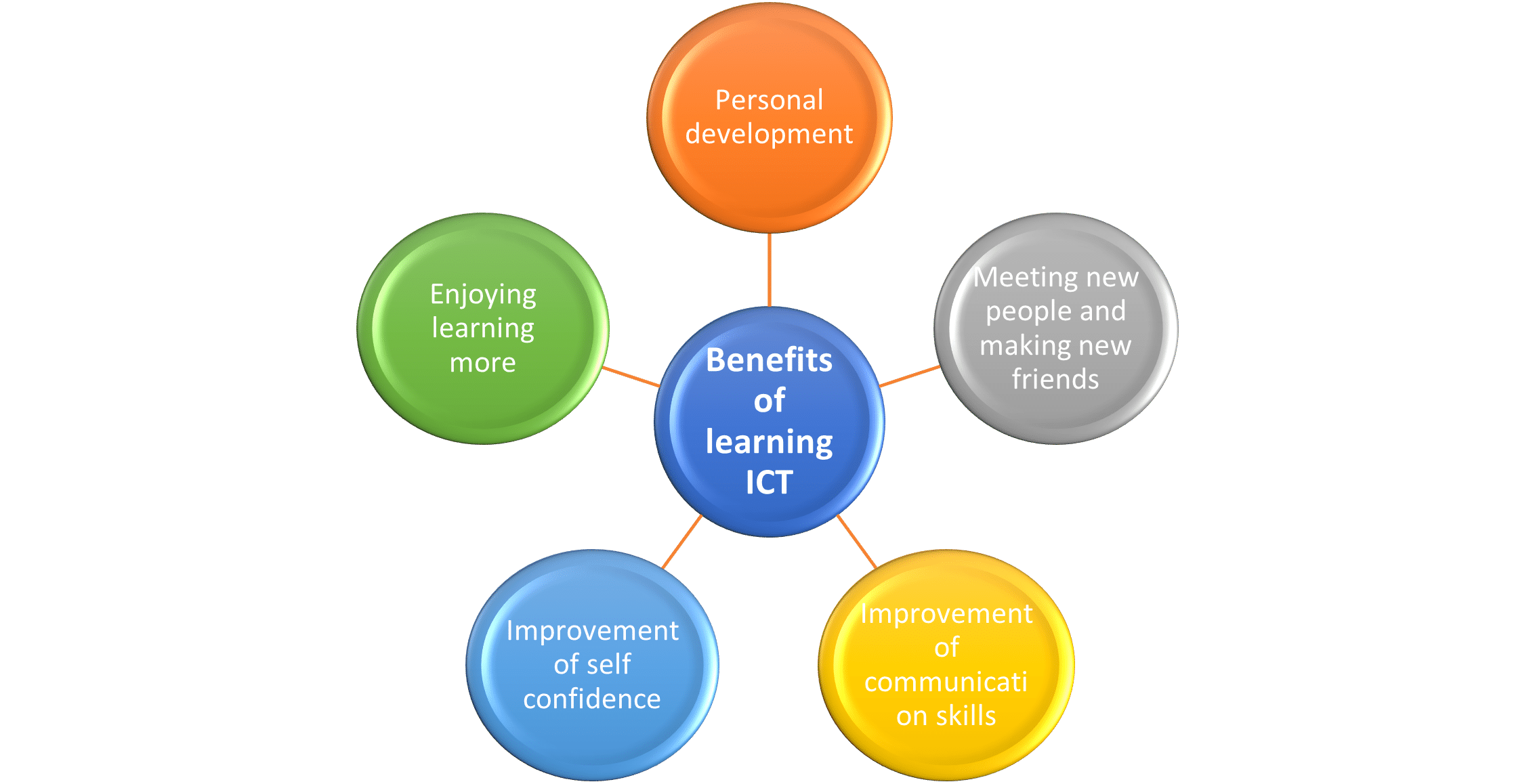
Graphic 2. Benefits of learning ICT
5 ways to motivate seniors
There are lot of ways to motivate seniors to learn how to use new technology. Lets’ see 5 of them:
- Set few and manageable goals
Goals are beneficial for seniors as they can keep them oriented and motivated to succeed. What seniors need are few and manageable objectives so as to be able to achieve them. They need support for every step they make and every task they complete.
- Make them talk about their past
Every older person has a story to share about his experiences and adventures when he was young. If you show them that you are interested in learning about their past, they will be happy to share those stories with you. As you listen those stories, ask questions to deepen into the details of their lives. They will feel emotionally safe and you will build a strong relationship with them making them trust you.
- Highlight the benefits of technologies
The internet is a tool which offers amazing opportunities not only to young, but also to older people. Technology helps more and more people to be connected with their families and friends. Connection helps people to be active and have their independence and not to be isolated. Nowadays, social networking platforms are popular also to older people.
- Make them feel useful
Older people want to feel that they are useful no matter their age or how limited their functions are. You have to discover areas that a senior can feel needed, such as asking their advice or their opinion for a personal matter due to their experience.
- Make them feel comfortable
Seniors usually are afraid to learn something they don’t understand. You should make them feel comfortable and you should encourage their self-confidence regarding using technology. This will help them to be engaged with the educational procedure and will motivate them to develop their IT skills. For example, you can help them to identify realistic goals, to choose alternative methods to achieve their goals, to complete a task.